
- Renewable energy accounted for ₱1.38 trillion, or 83%, of the ₱1.62 trillion in investments approved by the Board of Investments in 2024.
- Solar PV accounted for 3,060 projects among renewable-energy facilities cited in the country’s committed energy project pipeline as of January 2025.
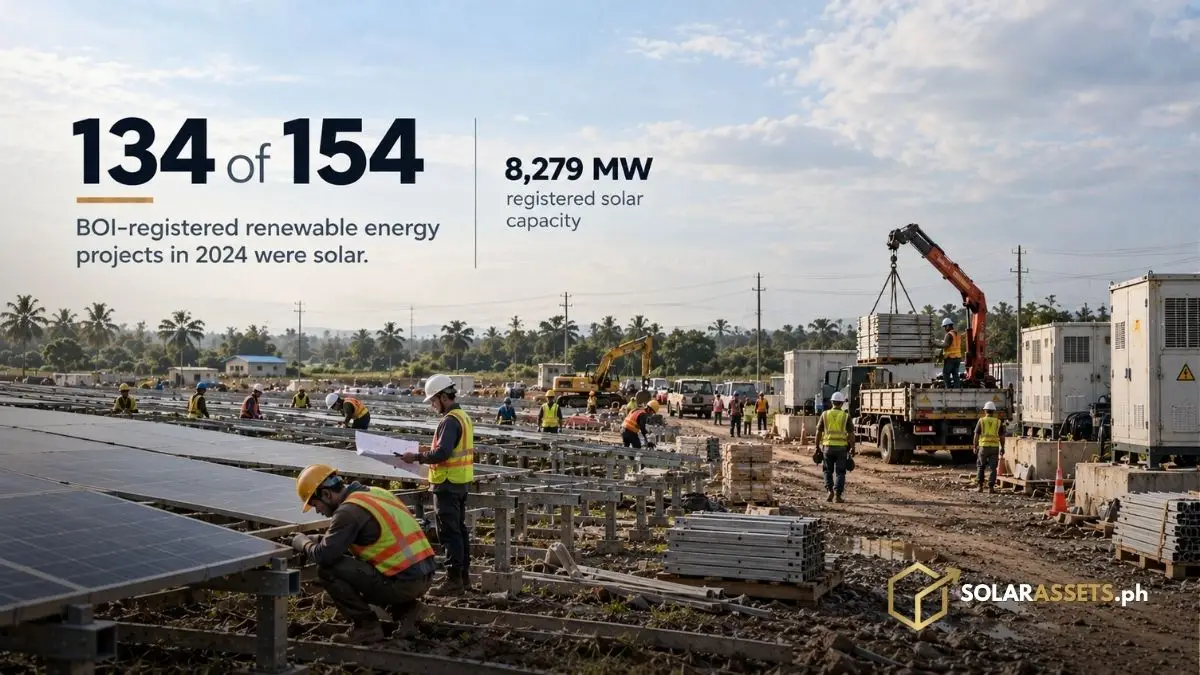
- Solar represented 134 of 154 BOI-registered renewable-energy projects in 2024, with a combined capacity of 8,279 MW.
- Established solar developers are already operating projects across several Philippine regions, showing that development extends beyond a single solar hub.
- Converting the growing project pipeline into operating capacity will continue to depend on suitable sites, infrastructure, grid access, financing, and project development.
Solar Is Taking a Larger Role in Philippine Renewable Energy Development
Renewable energy development in the Philippines continues to expand as electricity demand grows and the country works toward increasing the contribution of cleaner energy sources to its power generation mix.
The scale of investment already moving into the sector reflects this transition. According to the Philippine Board of Investments’ Renewable Energy Industry Profile, the BOI approved ₱1.62 trillion in investments during 2024, with ₱1.38 trillion, or 83% of the total, allocated specifically to renewable-energy projects. These investments supported 449 projects. Renewable-Energy
The Philippines aims for renewable energy to account for 35% of its power generation mix by 2030, 50% by 2040, and more than 50% by 2050. Reaching those targets will require continued development across solar, wind, geothermal, hydropower, biomass, and other energy technologies. Renewable-Energy
Within this broader expansion, however, solar stands out because of the number of projects entering the development pipeline.
In January 2025, the Department of Energy reported nearly 7,000 committed energy projects in the local sector. The BOI profile states that 5,754 of these were located in Luzon, including 3,923 renewable-energy facilities. Solar PV accounted for 3,060 projects, demonstrating the particularly large amount of development activity surrounding the technology. Renewable-Energy
The significance for the Philippine solar industry is therefore not simply another large renewable-energy investment figure. Thousands of individual projects are moving through different stages of development, creating opportunities for developers, investors, infrastructure providers, landowners, and other stakeholders participating in the country’s energy transition.
Solar Accounted for 134 of 154 BOI-Registered Renewable Projects
The prominence of solar becomes even clearer in the Board of Investments’ registration figures.
The BOI recorded 154 renewable-energy projects representing 9,845 MW of capacity in 2024, distributed across four major technologies:
- Solar: 134 projects representing 8,279 MW
- Wind: 12 projects representing 928 MW
- Hydropower: 6 projects representing 428 MW
- Geothermal: 2 projects representing 58 MW
Solar therefore represented approximately 87% of BOI-registered renewable-energy projects and 84% of their combined capacity during the year. Renewable-Energy
These figures do not mean that solar is replacing the country’s other renewable resources. Geothermal and hydropower remain established parts of the Philippine energy system, while wind development continues to expand. Different technologies will continue to serve different technical, geographic, and energy requirements.
What the figures demonstrate is the scale of current project development surrounding solar. National renewable-energy targets ultimately have to become individual operating projects, each requiring capital, technical planning, regulatory approvals, infrastructure, viable sites, and grid connectivity.
Major Developers Are Already Active Across the Solar Market
The growing solar pipeline is supported by an increasingly established development landscape.
The BOI profile identifies operating solar projects involving companies including Citicore Renewable Energy Corporation, PetroSolar Corporation, Solar Philippines Tarlac Corporation, Helios Solar Energy Corporation, Santa Cruz Solar Energy, Gigasol3, Jobin-SQM, and Natures Renewable Energy Development Corporation. Renewable-Energy
Their listed projects span several parts of the Philippines, including Zambales, Negros Occidental, Pangasinan, Cagayan, Pampanga, Tarlac, and Bataan. This geographic spread shows that solar activity is not limited to a single renewable-energy hub or development corridor. Renewable-Energy
The wider renewable-energy industry also includes major companies active across geothermal, hydropower, wind, biomass, and other technologies. Together, these developers form part of a broader commercial ecosystem in which renewable energy is becoming an increasingly significant infrastructure and investment sector, with solar accounting for a particularly large share of current project activity.
Policies Are Creating More Pathways for Renewable Development
Renewable-energy expansion is also taking place within a policy environment designed to encourage greater investment and participation.
The Renewable Energy Act provides incentives for qualified developments, while current rules allow 100% foreign ownership of inexhaustible renewable-energy resources including solar, wind, biomass, and ocean or tidal energy.
The BOI profile identifies several mechanisms supporting the wider sector, including:
- Tax and duty incentives for qualified renewable-energy investments
- Renewable-energy financing programs
- Feed-in tariffs and net metering
- Renewable Portfolio Standards and the Renewable Energy Market
- Green Lanes intended to streamline approvals for strategic investments
- The Green Energy Auction Program for competitive procurement of renewable capacity
These programs address different parts of renewable-energy investment, development, generation, and market participation. Renewable-Energy Renewable-Energy
The BOI profile does not establish that these policies alone explain solar’s large project count. Rather, they provide part of the broader investment and regulatory environment in which Philippine solar development is taking place.
Solar Potential Still Has to Become Operating Capacity
The size of the project pipeline also highlights an important difference between potential capacity and actual operating generation.
As of December 31, 2024, the BOI profile lists approximately 157,951 MW of potential capacity across DOE-awarded renewable-energy projects, compared with approximately 6,597 MW of installed capacity within the same dataset. Renewable-Energy
Solar illustrates this gap clearly. DOE-awarded solar projects represented approximately 37,986 MW of potential capacity, while installed solar capacity in the dataset stood at approximately 2,219 MW. Renewable-Energy
The comparison puts the thousands of solar projects in the development pipeline into perspective. Proposed and awarded capacity must still progress through project evaluation, approvals, financing, construction, grid connection, and other development requirements before it becomes operating generation.
The opportunity is therefore not simply in increasing the number of projects. The longer-term challenge is successfully converting viable projects into productive renewable-energy assets.
Suitable Land Becomes More Important as the Pipeline Expands
Land is one of the physical foundations of utility-scale solar development.
The BOI profile includes maps of the Philippines’ Competitive Renewable Energy Zones, showing areas identified for optimized solar PV and wind development. These maps illustrate how renewable-energy potential varies geographically across the country. Renewable-Energy
Resource potential alone, however, does not determine whether a property can support a viable solar project. Developers must also consider the characteristics of the site and its surrounding development environment. Land configuration, access, proximity to transmission infrastructure, project scale, regulatory requirements, environmental considerations, and competing land uses can influence how a prospective location is evaluated.
As the solar pipeline expands, this becomes increasingly relevant to landowners and property stakeholders. Properties traditionally considered for agricultural, industrial, or other real-estate uses may also be evaluated for their renewable-energy development potential.
Not every large parcel will be suitable for solar development. Instead, the growing pipeline increases the importance of identifying locations where land conditions, infrastructure, energy resources, and project requirements can align.
From a Growing Pipeline to a Stronger Solar Market
The Philippine renewable-energy transition will continue to require a diverse mix of technologies. Geothermal, hydropower, wind, biomass, solar, and supporting infrastructure each have roles within the country’s evolving energy system.
Within that wider transition, however, the BOI figures provide a clear picture of solar’s current development momentum. Solar PV accounts for 3,060 projects among the renewable-energy facilities cited in the committed project pipeline, while 134 of the 154 renewable-energy projects registered with the BOI in 2024 were solar developments. Renewable-Energy Renewable-Energy
The next stage is turning that pipeline into operating capacity.
Doing so will bring together energy developers, domestic and international investment, government agencies, infrastructure providers, communities, and owners of potential development sites. As more projects advance, solar’s growing pipeline could increasingly influence where and how renewable-energy development takes place across the Philippines.
The BOI profile cites DOE figures showing 3,060 solar PV projects among renewable-energy facilities committed to the sector as of January 2025. Renewable-Energy
Solar accounted for 134 of 154 projects, representing 8,279 MW of the 9,845 MW of renewable capacity registered during the year. Renewable-Energy
The BOI report identifies projects across locations including Zambales, Negros Occidental, Pangasinan, Cagayan, Pampanga, Tarlac, and Bataan. Renewable-Energy
Utility-scale solar developments require locations where property characteristics can align with infrastructure, grid access, regulatory requirements, technical considerations, and commercial feasibility.
Solar Assets PH works with landowners, property agents, developers, and renewable-energy stakeholders to help connect potential sites with opportunities in the Philippine solar sector. As more projects move through different stages of development, identifying suitable locations will remain an important part of translating the country’s renewable-energy ambitions into operating solar capacity.