
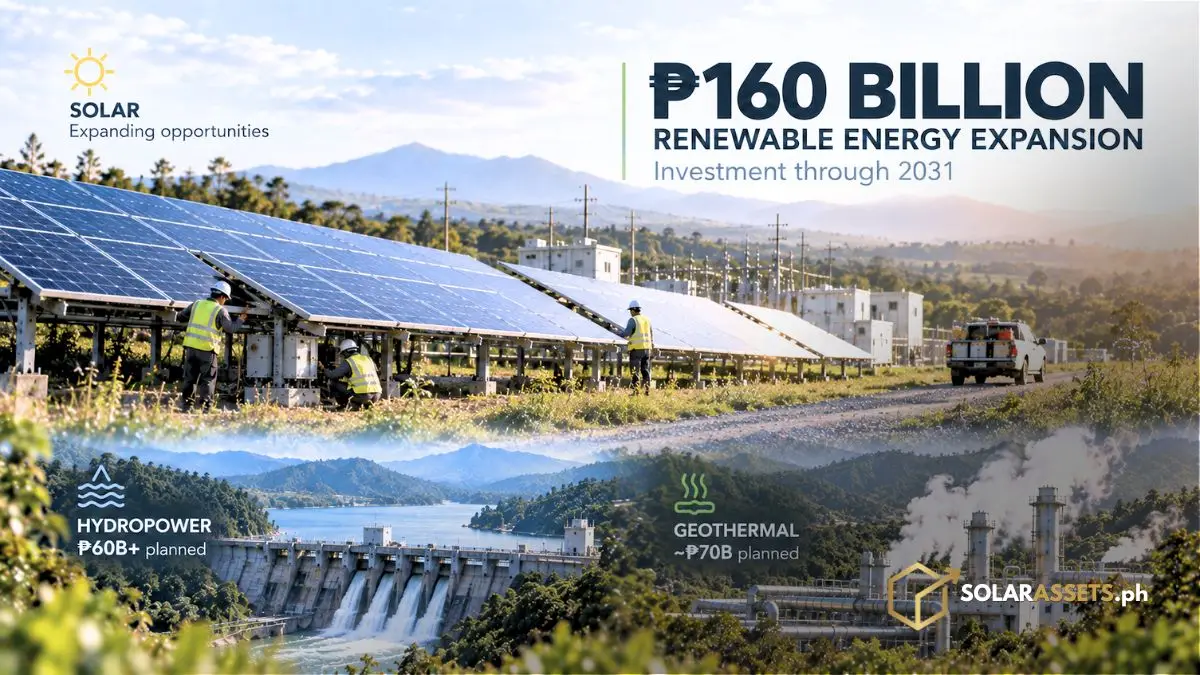
- First Gen Corp. is considering ₱150 billion to ₱160 billion in capital expenditures through 2031 for renewable-energy projects across geothermal, hydropower, solar, and other opportunities.
- More than ₱60 billion could support hydropower projects, while around ₱70 billion may be allocated to geothermal exploration and expansion. The investment figures have not yet been finalized.
- Solar represents a smaller share of First Gen’s existing portfolio but remains part of its development pipeline, including a 54-MW agrivoltaic project in Batangas.
- Pumped-storage hydropower and battery storage are becoming increasingly important as more variable solar and wind capacity connects to the Philippine grid.
- The scale of the proposed investment demonstrates how renewable-energy development increasingly requires generation, storage, transmission, land, and long-term capital to progress together.
First Gen Plans Up to ₱160 Billion in Renewable Energy Investment
One of the Philippines’ largest renewable-energy producers is preparing for another major period of expansion.
First Gen Corp. said capital expenditures through 2031 could reach approximately ₱150 billion to ₱160 billion, with investments expected across geothermal, hydropower, solar, and other renewable-energy opportunities.
First Gen President Francis Giles Puno said the figures are still being finalized. Current plans include more than ₱60 billion for hydropower opportunities and approximately ₱70 billion for geothermal exploration and expansion, accounting for roughly ₱130 billion of the potential investment before additional renewable projects, including solar, are considered.
The announcement illustrates the scale of capital now being considered for the next generation of Philippine renewable-energy infrastructure.
It also shows that renewable expansion is becoming increasingly interconnected. Building more generation capacity is only one part of the equation. Storage, transmission, grid reliability, suitable development sites, and the ability to integrate different renewable technologies are becoming equally important.
The Investment Builds on an Already Large Renewable Portfolio
First Gen enters this expansion period with an established renewable-energy base.
At the end of 2025, the company reported 1,764.2 MW of installed renewable capacity, comprising 1,302.8 MW of geothermal, 299.4 MW of hydropower, 150 MW of wind, and 12 MW of solar, alongside 40 MWh of battery storage. The company says its portfolio accounts for roughly one-quarter of renewable electricity generated in the Philippines.
Its current portfolio also demonstrates why the proposed ₱160 billion program should not be interpreted as a predominantly solar investment.
Geothermal and hydropower remain the largest components of First Gen’s renewable operations, while solar represents a much smaller but developing part of its pipeline.
This distinction matters as renewable investment accelerates across the Philippines. Different technologies perform different roles within the power system, and the growth of one can create infrastructure requirements and opportunities for another.
Solar Remains Part of the Next Renewable Development Pipeline
Although geothermal and hydropower account for most of the announced capital requirements, First Gen continues to develop solar opportunities.
One example is Project Inara in Batangas, a planned 54-MW agrivoltaic development. The project is designed to elevate photovoltaic panels so agricultural activity can continue on the land below while the site simultaneously produces electricity.
The approach is particularly relevant to Philippine solar development because land is one of the fundamental requirements of utility-scale projects.
Agrivoltaics represents one potential model for balancing renewable-energy generation with existing agricultural activity rather than treating the two uses as automatically incompatible.
First Gen has also reported additional wind and solar opportunities moving through feasibility studies, permitting, and grid-integration stages. Meanwhile, its energy-solutions business energized more than 25 MW of rooftop solar across 26 commercial and industrial sites in 2025.
Together, these projects show how solar development can take several forms, from utility-scale land developments to installations serving commercial and industrial facilities.
Energy Storage Is Becoming More Important as Solar Capacity Expands
Increasing renewable generation also changes what the Philippine power system needs around it.
Solar generation is strongest during daylight hours, while electricity demand continues after the sun sets. As greater volumes of solar and wind enter the grid, storage and other flexible generation resources can help move electricity across different periods of demand.
First Gen is consequently investing heavily in hydropower and storage infrastructure alongside renewable generation.
The company holds a 33% stake in Prime Hydropower Energy Inc., which is developing the Wawa and Pakil pumped-storage projects. First Gen has said these facilities are intended to provide grid flexibility and support the integration of additional renewable-energy projects.
Its geothermal portfolio has also incorporated battery storage. Three battery energy storage systems entered commercial operation in 2025, providing a combined 40 MWh of storage capacity.
For the Philippine solar industry, this points toward a broader development environment where generation and storage increasingly need to be considered together.
Renewable Expansion Creates a Larger Need for Suitable Development Sites
Every large renewable-energy project eventually becomes a land and infrastructure project as well.
Solar developments require sites with sufficient solar exposure, usable terrain, road access, proximity to transmission infrastructure, and enough contiguous land to support their planned capacity. Developers must also consider permitting, grid availability, environmental conditions, land ownership, and surrounding land uses before construction can proceed.
Other renewable technologies have their own geographic requirements.
Geothermal projects depend on viable underground resources. Hydropower depends on suitable water resources and terrain. Pumped-storage facilities require locations capable of supporting upper and lower reservoirs as well as connections to the power system.
The scale of First Gen’s proposed investment therefore represents more than expenditure on generating equipment. It reflects the physical development requirements involved in expanding renewable infrastructure across multiple Philippine locations.
For landowners, project developers, investors, and other participants in the renewable-energy market, identifying appropriate sites early can become an important part of moving projects from initial opportunity to viable development.
Grid Infrastructure Will Influence Where Renewable Projects Can Grow
Available renewable resources do not automatically translate into usable electricity.
Transmission capacity determines whether power generated in one location can reach demand elsewhere.
This issue is already visible in Leyte, where First Gen is evaluating a major redevelopment of its geothermal facilities. Company executives have pointed to transmission constraints that can prevent all available geothermal energy from being delivered to demand centers. The proposed redevelopment could increase the complex’s output from roughly 400 MW to at least 640 MW, subject to ongoing evaluation and engineering studies.
The same issue becomes increasingly important for solar.
A site may have strong solar conditions and sufficient land, but inadequate grid capacity can affect development schedules, connection costs, and ultimately project viability.
This is why renewable-energy development increasingly involves evaluating land, generation potential, storage, transmission access, and future grid capacity together rather than treating each as a separate concern.
Philippine Renewable Energy Investment Continues to Scale Up
First Gen’s planned spending forms part of a much wider renewable-energy transition underway in the Philippines.
The Philippine Energy Plan targets a renewable-energy share exceeding 50% of the country’s power mix by 2050, while the government continues to pursue investment reforms and streamlined processes intended to accelerate clean-energy infrastructure.
Large capital commitments from established energy companies provide one indication of what achieving that transition can require in practice.
New generating facilities must be financed and constructed. Existing assets require modernization. Transmission networks need sufficient capacity. Storage must grow alongside variable generation. Developers need appropriate project sites, while permitting and grid connections must progress before projects can become operational.
For solar development specifically, the opportunity therefore extends beyond simply adding photovoltaic capacity.
Solar is becoming one component of a larger renewable-energy system in which land availability, energy storage, transmission infrastructure, financing, and complementary generation technologies increasingly determine how quickly projects can move forward.
First Gen has indicated potential capital expenditures of approximately ₱150 billion to ₱160 billion through 2031, although the final amount has not yet been determined.
Current estimates include more than ₱60 billion for hydropower opportunities and approximately ₱70 billion for geothermal exploration and expansion, with additional investment potentially going toward solar and other renewable projects.
No. Geothermal and hydropower account for the largest identified allocations. Solar is part of First Gen’s broader renewable development pipeline but represents a much smaller portion of its existing installed portfolio.
Its disclosed pipeline includes the planned 54-MW Project Inara agrivoltaic development in Batangas, while additional wind and solar opportunities are progressing through development stages.
Solar generation varies according to daylight and weather conditions. Storage and flexible power resources can help balance generation and demand, while adequate transmission capacity is necessary to deliver electricity from renewable-energy sites to consumers.
As renewable-energy investment expands across the Philippines, suitable land remains an important part of bringing new projects into development.
Solar Assets PH connects landowners, agents, developers, and investors involved in solar-energy opportunities, from raw land with development potential to shovel-ready projects and operational renewable-energy assets.
Connect with Solar Assets PH to explore land and project opportunities supporting the next generation of Philippine solar development.