
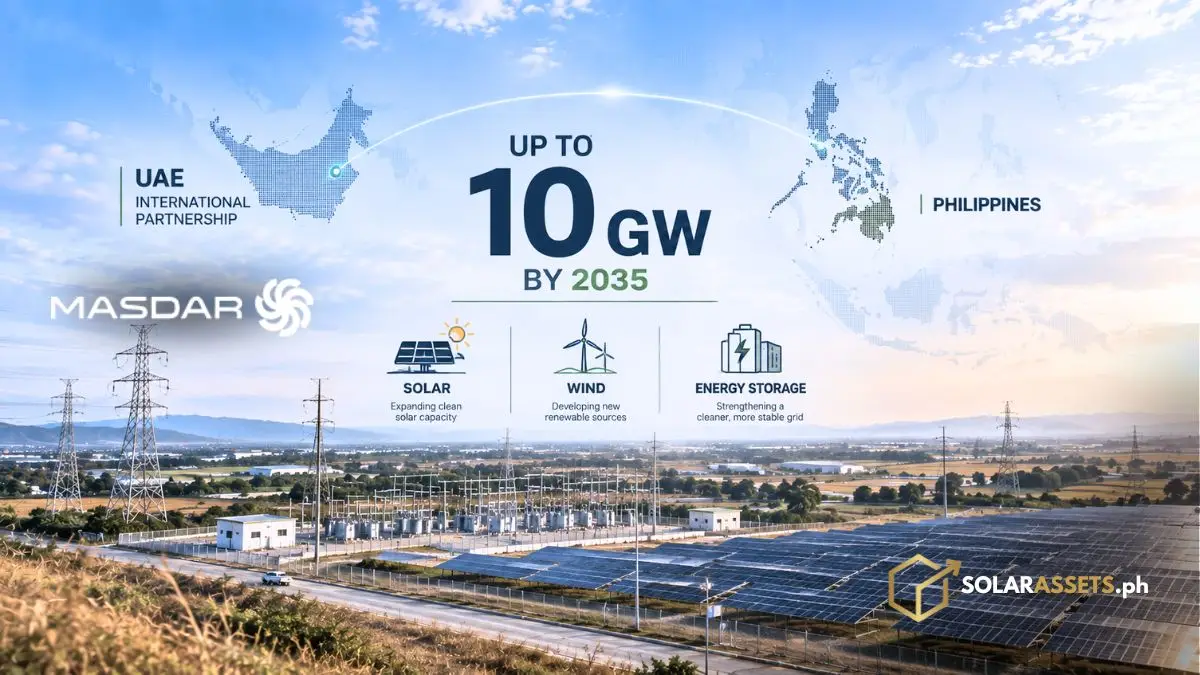
- Abu Dhabi-based clean energy company Masdar is exploring further energy investment opportunities in the Philippines.
- Solar remains an important part of Masdar’s Philippine renewable energy plans alongside wind and battery energy storage systems.
- Masdar’s Philippine plans have expanded from an initial target of up to 1 GW of renewable energy capacity by 2030 to support for up to 10 GW by 2035.
- Future renewable energy development could support major economic and infrastructure areas, including the Luzon Economic Corridor.
- Continued international investment strengthens opportunities for utility-scale solar development and suitable project locations across the Philippines.
Good news for the Philippine solar and renewable energy sector as Abu Dhabi-based clean energy company Masdar signals continued interest in expanding its investments in the country.
Masdar is not new to the Philippine market. In January 2025, the company entered into agreements with the Philippine government covering the development of solar, wind, and battery energy storage systems, initially targeting up to 1 GW of renewable energy capacity by 2030. The partnership was also positioned to support renewable energy development across different regions of the country, particularly around the Luzon Economic Corridor connecting Subic Bay, Clark, Manila, and Batangas.
That commitment has since grown. In May 2026, the Philippine Board of Investments reported that Masdar’s ongoing plans could support the development of up to 10 GW of renewable energy projects in the Philippines by 2035. Discussions have also explored renewable energy solutions for a planned AI-oriented industrial hub in Luzon, illustrating how future energy development could increasingly intersect with the country’s industrial and digital infrastructure requirements.
Solar Remains Part of a Broader Clean Energy Opportunity
Masdar’s Philippine plans span several technologies rather than focusing exclusively on one source of renewable power. Areas already identified for development include:
- Utility-scale solar energy
- Wind power
- Battery energy storage systems
- Integrated renewable energy solutions supporting major infrastructure and industrial developments
Solar nevertheless remains particularly relevant as the Philippines expands its renewable energy capacity. Masdar has extensive experience developing utility-scale solar and storage projects internationally, while its Philippine agreements specifically include solar as part of the country’s planned renewable energy pipeline.
Masdar’s expanding presence in Asia also provides additional context for its Philippine plans. In April 2026, the company and TotalEnergies announced a $2.2 billion joint venture covering solar, wind, and battery storage development across nine Asian markets, including the Philippines.
For the Philippine solar sector, continued interest from a developer of this scale signals more than additional generation capacity. Future projects will require suitable land, viable grid connections, supporting infrastructure, local partnerships, and locations capable of accommodating utility-scale development.
What Expanding International Investment Means for Philippine Solar
Masdar’s growing interest comes as renewable energy development continues to spread across the Philippines. For solar in particular, large-scale investment can create opportunities not only for new generation capacity but also for the land, transmission infrastructure, storage systems, and local partnerships needed to support future projects.
The scale of Masdar’s plans also means that potential development is unlikely to depend on a single location. Its earlier Philippine agreement identified opportunities across different regions, with particular attention to the Luzon Economic Corridor, which connects major economic and infrastructure centers from Subic Bay and Clark through Metro Manila to Batangas.
As developers evaluate new solar opportunities, several factors can influence where projects ultimately move forward:
- Available land with sufficient area for utility-scale development
- Solar resource potential and appropriate site conditions
- Access to transmission and grid infrastructure
- Proximity to growing industrial and economic centers
- Supporting roads and infrastructure
- Local permitting, land-use requirements, and stakeholder coordination
These considerations make location increasingly important as renewable energy commitments move from investment targets toward actual projects.
From Investment Commitments to Solar Development
The Philippines is targeting renewable energy to account for 35 percent of its power generation mix by 2030 and 50 percent by 2040. Achieving those targets will require investment commitments to translate into viable projects across different parts of the country.
For solar developers, this creates a growing need to identify locations where land availability, infrastructure, and project requirements can align. International investment from companies such as Masdar can strengthen that pipeline, but individual projects will still depend on detailed technical, commercial, environmental, and regulatory assessments before development can proceed.
For landowners and local stakeholders, the continued expansion of Philippine solar also creates opportunities to understand whether suitable properties could play a role in the country’s renewable energy transition.
Masdar is exploring further clean energy investment opportunities in the country. Its existing Philippine plans cover solar, wind, and battery energy storage systems, with ongoing plans supporting the development of up to 10 GW of renewable energy projects by 2035.
No. Masdar is pursuing a broader renewable energy strategy that includes solar, wind, and energy storage. Solar nevertheless remains an important part of its Philippine plans and its wider development activities across Asia.
Specific locations will depend on individual project assessments. Masdar’s earlier Philippine agreement identified opportunities across different regions, including areas associated with the Luzon Economic Corridor, while future projects will depend on factors such as land availability, grid connectivity, infrastructure, permitting, and technical feasibility.
Continued investment can help expand the country’s renewable energy pipeline while increasing demand for suitable project locations, grid infrastructure, energy storage, and local partnerships needed to bring utility-scale solar projects into development.
As international investment strengthens the Philippine renewable energy sector, identifying viable locations will be an important part of turning ambitious capacity targets into operating projects. Solar Assets PH works with landowners, developers, businesses, and investors to explore solar development opportunities and connect suitable properties with the country’s growing clean energy market.