
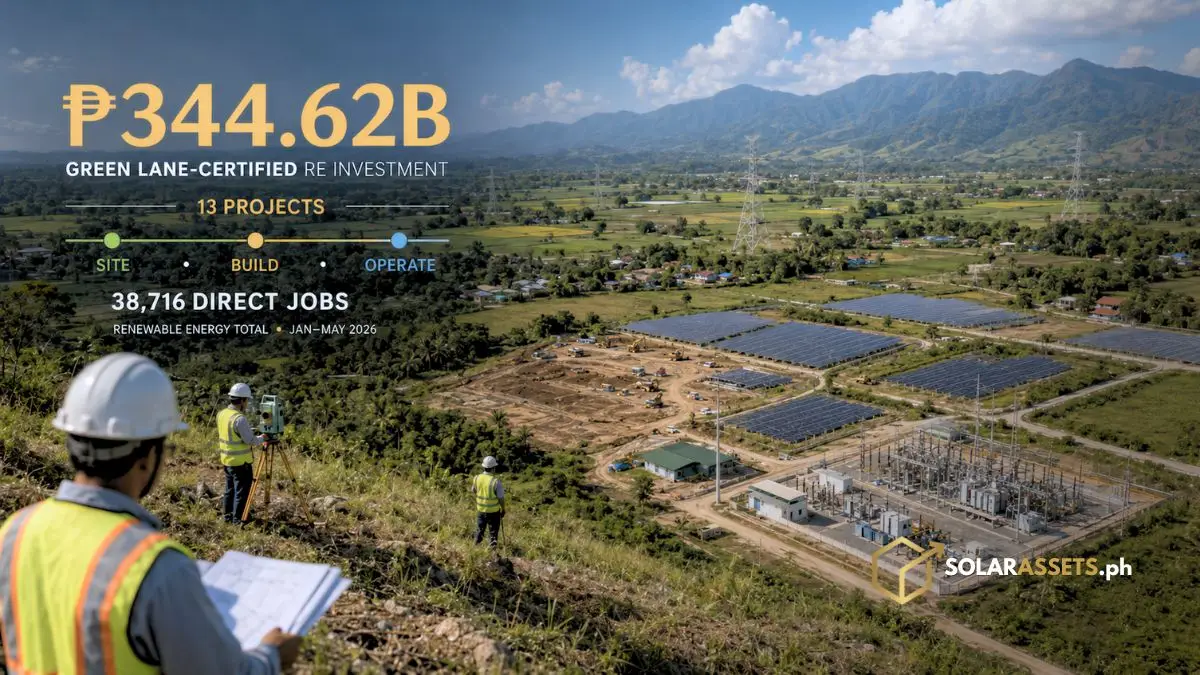
- Thirteen renewable energy projects worth ₱344.62 billion received Green Lane certification during the first five months of 2026.
- The projects are expected to generate 38,716 direct jobs once operational.
- Major developments in the 2026 Green Lane pipeline include projects in Pangasinan, Samar, Nueva Ecija, and other parts of the Philippines.
- Wind currently represents a significant share of the named projects, while floating solar, hydropower, and other renewable technologies demonstrate a diversifying energy pipeline.
- Continued renewable energy investment creates a stronger development environment for future solar projects across the country.
Investment in renewable energy projects in the Philippines continues to accelerate as developers advance large-scale energy developments across multiple regions and technologies.
During the first five months of 2026, 13 renewable energy projects with a combined investment value of approximately ₱344.62 billion received Green Lane certification. These projects are expected to generate 38,716 direct jobs, demonstrating the scale of capital and development activity entering the country’s renewable energy sector.
The pipeline is also becoming geographically diverse. Projects identified by the Board of Investments during the January–April period include the Pangasinan Wind Farm, Samar Wind Farm, Nueva Ecija Wind Farm, and Bulalacao Bay Offshore Wind Project, alongside developments led by San Jose Onshore Wind Power Corporation, Ilosong Wind Corp., Energia Pulita Energy Corp., Sembrano Wind Power Corp., and 5Hour Peak Energy Corp.
While the ₱344.62 billion figure represents renewable energy investment broadly rather than solar investment alone, the scale and geographic reach of these projects show how rapidly the country’s clean-energy development landscape is expanding.
Renewable Energy Investment Is Spreading Across the Philippines
Several of the largest projects identified by the BOI illustrate the regional scale of this investment pipeline. The Pangasinan Wind Farm represents ₱52.31 billion in investment, while wind farms in Samar and Nueva Ecija are valued at ₱43.59 billion each. The Bulalacao Bay Offshore Wind Project represents another ₱88.32 billion in planned investment.
Other Green Lane-certified developments include projects by San Jose Onshore Wind Power Corporation, Ilosong Wind Corp., Energia Pulita Energy Corp., and Sembrano Wind Power Corp. Together with hydropower developments by Alsons Energy Development Corporation and Oriental Energy and Power Generation Corporation, these projects demonstrate how renewable energy investment is expanding across different technologies and locations.
Solar is also represented in the pipeline through 5Hour Peak Energy Corp.’s ₱5.88 billion floating solar project, which is expected to generate 1,760 jobs. Its inclusion alongside major wind and hydropower investments demonstrates the increasingly diverse approaches being explored to expand Philippine renewable energy capacity.
What Growing Renewable Energy Investment Means for Philippine Solar
The Green Lane pipeline is not exclusively solar, but its scale signals a broader development environment that can support continued solar expansion across the Philippines. The January–April cohort itself included 5Hour Peak Energy Corp.’s ₱5.88 billion floating solar project, alongside major wind and hydropower developments.
Other solar developments moving forward in 2026 reinforce that momentum. In Ilocos Norte, the Green Lane-certified Astra Solar Power Project in Currimao and Opus Solar Project in Paoay broke ground in May. Opus alone covers approximately 190 hectares and has a planned capacity of 416.025 MWp. Central Luzon has also attracted major solar investment, including a ₱16.4 billion project by Cleanenergy 2 Power Inc. identified by the BOI earlier this year.
These developments show how Philippine solar opportunities are emerging across different regions and project models, from conventional utility-scale developments to floating solar installations.
Turning Investment Momentum Into Viable Solar Projects
Strong investment figures do not automatically translate into operating solar facilities. Projects still depend on suitable sites, land availability, grid connectivity, permitting, financing, infrastructure, and coordination between developers, government agencies, communities, and other stakeholders.
This is particularly important as projects move from investment approval into implementation. The Green Lane initiative is designed to reduce permitting and coordination delays by providing qualified strategic investments with a single point of entry for government facilitation.
For solar development, identifying appropriate land remains one part of that process. Properties with sufficient area, viable solar exposure, appropriate land conditions, and practical access to transmission and other supporting infrastructure can help developers determine where future projects may be feasible.
As the Philippines works toward renewable energy accounting for 35 percent of the power generation mix by 2030 and 50 percent by 2040, the transition from investment commitments to viable sites and operating projects will become increasingly important.
It represents 13 renewable energy projects certified under the government’s Green Lane initiative during the first five months of 2026. The projects cover the broader renewable energy sector rather than solar alone and are projected to create 38,716 direct jobs.
Where are some of the Green Lane renewable energy projects located?
Named projects from the January–April cohort include major developments in Pangasinan, Samar, Nueva Ecija, and Bulalacao Bay, alongside other wind, floating solar, and hydropower projects.
Yes. Among the projects identified by the BOI is 5Hour Peak Energy Corp.’s ₱5.88 billion floating solar project. Separate Green Lane-certified solar developments are also progressing in areas such as Ilocos Norte.
Potential sites need to be assessed for factors including available area, solar exposure, land conditions, grid and transmission access, infrastructure, permitting requirements, and overall project feasibility.
As renewable energy investment expands across the Philippines, suitable locations will play an important role in turning ambitious capacity targets into operating solar projects. Solar Assets PH works with landowners, developers, businesses, and investors to explore solar development opportunities and connect promising properties with the country’s growing renewable energy sector.